Weak Breadth, Better Reflexes, Still No Clean Risk-On Flip

Executive Takeaway
The Binance weekly close for the week ending 2026-05-25 remained defensive: the dominant regime was still Weak Downtrend, with 213 of 406 assets in that bucket and a market conviction score of 4.0/10. The improvement was real but incomplete: positive rate-of-change assets rose from 31 to 143 week over week, bullish candles rose from 17 to 93, and bearish candles fell from 238 to 162. That is a better tape than the prior week, but not a clean trend reversal because 374 assets still had RSI below 50, 358 remained in bearish VWAP/price trend, and 259 still closed with negative momentum. BTC sentiment reinforces the cautious read: BTC slipped 0.51% for the week while open interest contracted, Coinbase premium stayed negative, and long liquidations remained dominant. The setup board therefore splits into two tactical families: support-bound mean reversion where assets have reclaimed support behavior, and bearish continuation where downside structure remains active. The key risk this week is assuming the mean-reversion bounce is already a broad risk-on regime. The better base case is selective two-way trading until breadth, BTC participation, and volume confirm otherwise.
Weekly Market State
The weekly market state closed as a low-conviction defensive tape with partial rebound pressure underneath. Weak Downtrend was the largest regime cluster at 213 assets, followed closely by Range-Bound at 201, while Strong Downtrend remained elevated at 119. That mix says the market improved from the prior washout but did not rotate into broad upside participation.
Breadth was still below the level required for a durable risk-on read. Positive momentum improved to 143 assets, but negative momentum still led at 259. RSI breadth remained weak, with only 32 assets above 50 and 374 below 50. Support was widespread, with 207 assets tagged at support and only 2 at resistance, so the market is more support-bound than breakout-led.
Trend pressure stayed bearish. Bearish lower lows were present across 247 assets, bearish lower highs across 222, and bearish VWAP/price trend across 358. Volume also leaned defensive, with 256 negative volume-delta assets versus 150 positive. The weekly close supports tactical rebounds, but the structure still requires confirmation before treating the move as a broad trend reversal.
What Changed From Last Week
- Breadth: Positive rate-of-change assets improved from 31 to 143, while negative rate-of-change assets fell from 374 to 259; the tape became less one-sided but stayed net negative.
- Support/candles: Bullish candles rose from 17 to 93 and bearish candles fell from 238 to 162; support behavior improved without a matching breakout expansion.
- Trend: Bullish VWAP/price trend rose from 37 to 48, while bearish VWAP/price trend eased from 368 to 358; the delta improved but the level remains heavily bearish.
- Structure: Bearish lower lows rose from 243 to 247, while bullish higher lows slipped from 94 to 90; downside structure did not clear.
- Regime: Low-Volatility Coil expanded from 31 to 55, Weak Uptrend rose from 25 to 34, and Weak Downtrend rose from 207 to 213; the market added compression and selective upside without leaving the downtrend regime.
- Conviction: Market conviction closed at 4.0/10; this supports scenario trading rather than directional certainty.
How the Week Unfolded
- May 18-19: The daily path began in Oversold Regime, with May 18 showing a relief impulse as positive momentum rose to 290 assets, then May 19 immediately rejected that improvement as negative momentum returned to 343 assets.
- May 20-21: The market attempted a broader repair, with positive momentum at 350 on May 20 and the dominant daily regime shifting from Oversold Regime to Weak Downtrend on May 21; that was improvement, but not a bullish regime flip.
- May 22: The path deteriorated sharply, with bearish regime count rising by 68 and negative momentum reaching 383 assets; this was the clearest warning that the rebound lacked durable breadth.
- May 23-24: The market stabilized into the close, with positive momentum recovering to 361 and range/coiling behavior expanding, but the dominant daily regime stayed Weak Downtrend.
BTC Sentiment
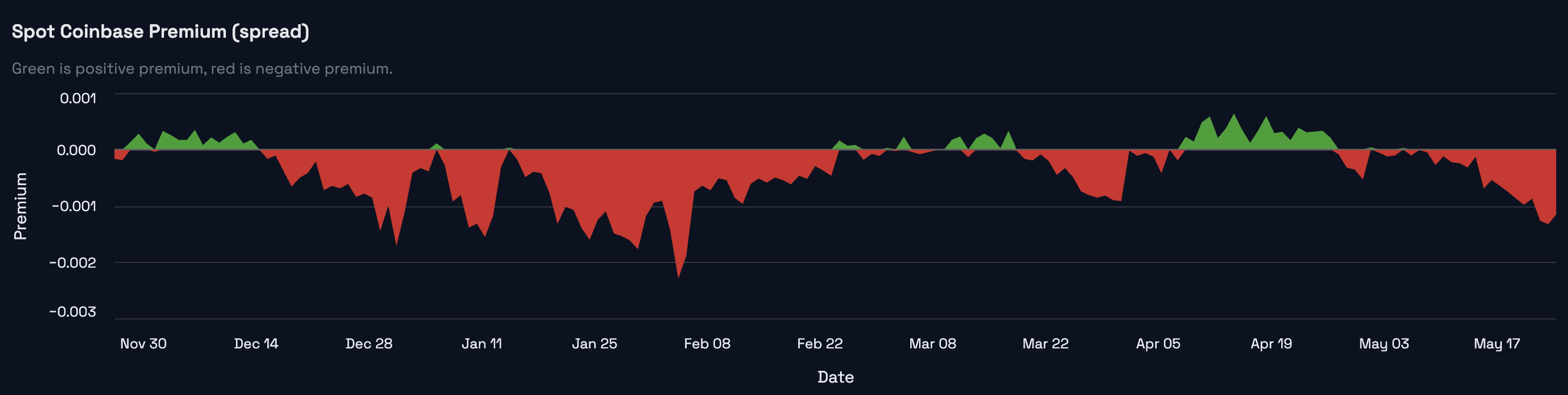
BTC sentiment was cautious and slightly bearish into the weekly close. BTC fell 0.51% from a 77,457.67 weekly open to a 77,064.96 close while open interest dropped by about $403.6M, which points to deleveraging rather than a fresh directional expansion. Coinbase premium remained negative, weakening from roughly -0.075% to -0.115%, so the data did not confirm strong U.S. spot support.
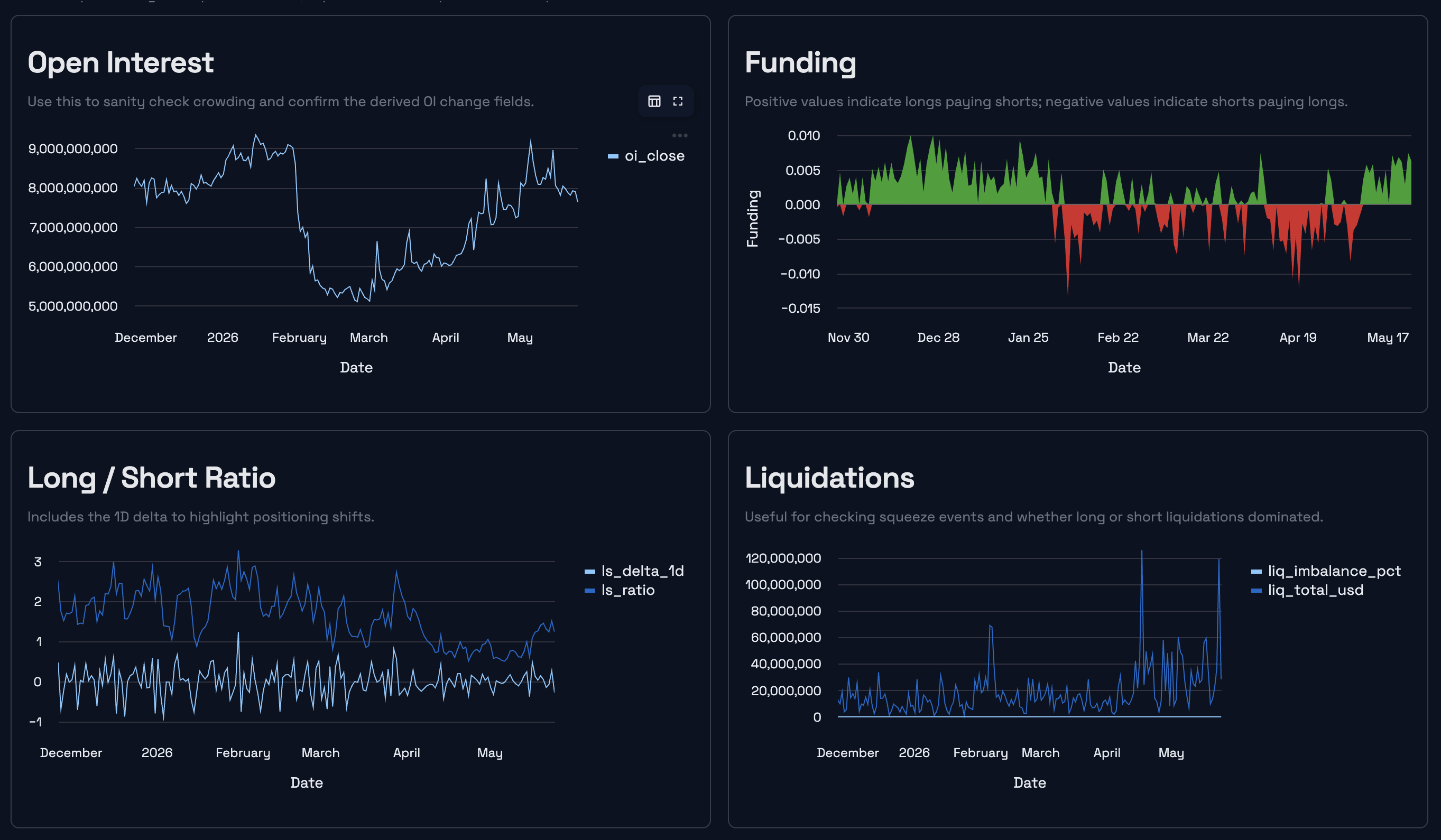
The late-week spot-flow picture was mixed. Spot CVD improved and spot volume delta turned positive into the end of the week, but that improvement did not override the broader contraction signal. Funding stayed positive, meaning longs were still paying shorts, while the latest one-day open-interest change was -3.31% and weekly open interest change was -2.22%. For the broader market, BTC argues for keeping risk appetite conditional until BTC shows cleaner spot demand and participation.
News and Catalysts
-
Is Bitcoin at risk as Coinbase premium hits monthly low? / crypto.news / 2026-05-22 Reporting focused on Bitcoin risk as Coinbase premium fell to a monthly low, pointing to weaker U.S. spot demand.
-
Bitcoin plugs leverage losses, but buyer interest remains low / ChainScoop.net / 2026-05-24 The report framed Bitcoin as absorbing leverage losses while buyer interest remained limited.
-
Bitcoin slides as Coinbase Bitcoin Premium Index signals reduced institutional accumulation / Mainstream Crypto News / 2026-05-23 Coverage tied Bitcoin weakness to reduced institutional accumulation through the Coinbase premium lens.
-
FOMC minutes reveal deeply divided Federal Reserve with hawkish bias / Crypto Briefing / 2026-05-20 Macro coverage highlighted a divided Fed with a hawkish bias.
-
Ethereum Foundation and Vitalik narrative / X posts / 2026-05-24 to 2026-05-25 X discussion focused on Vitalik Buterin describing a smaller, more specialized Ethereum Foundation and lower structural ETH selling pressure, while ETH ETF-flow chatter remained cautious.
Last Week Setup Scorecard
Last week's setup scorecard was mixed overall, with bearish continuation performing better than bullish mean reversion. The prior bearish setup group finished with a 4/5 hit rate on weekly direction, while the prior bullish setup group finished with a 1/5 hit rate. Classification logic was directional: short setups were judged successful when weekly close ROC was negative, long setups when weekly close ROC was positive; daily path metrics then separated clean wins from volatile wins and mixed outcomes.
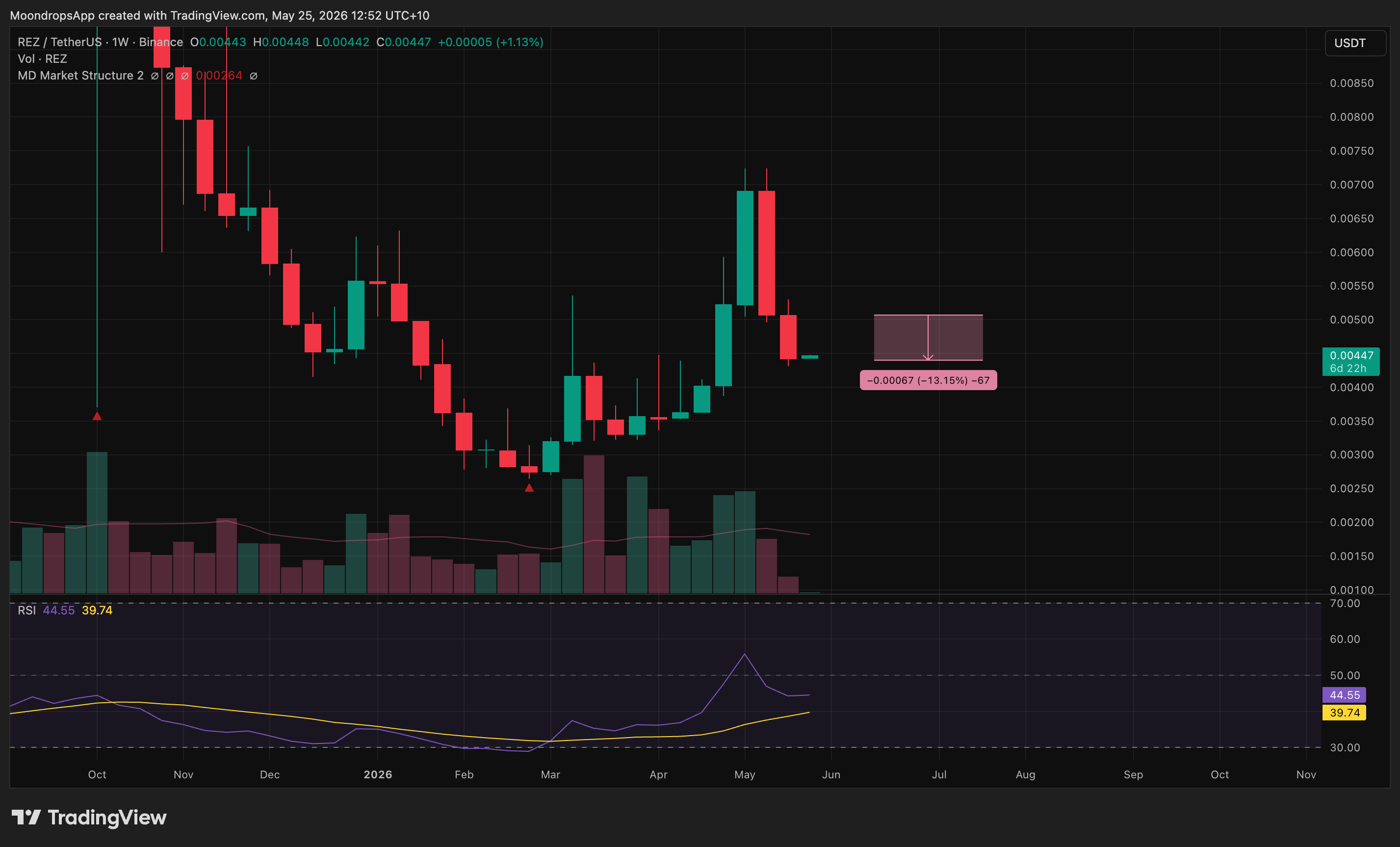
- Bearish continuation: REZUSDT, CITYUSDT, CETUSUSDT, and SAGAUSDT were volatile wins; RUNEUSDT was mixed after closing +2.03% despite four favorable short-direction days.
- Bullish mean reversion: WLDUSDT was a volatile win at +24.29%; TRUMPUSDT, PHBUSDT, SANDUSDT, and RESOLVUSDT were mixed after failing to close with convincing positive weekly direction.
- Intraweek path: The setup board had high path volatility. CITYUSDT, for example, closed -15.46% but had both a +2.73% best day and a -7.44% worst day, while WLDUSDT closed +24.29% after five favorable days and two adverse days.
Top Setups This Week
Trade Setups 1: Support-Bound Mean Reversion
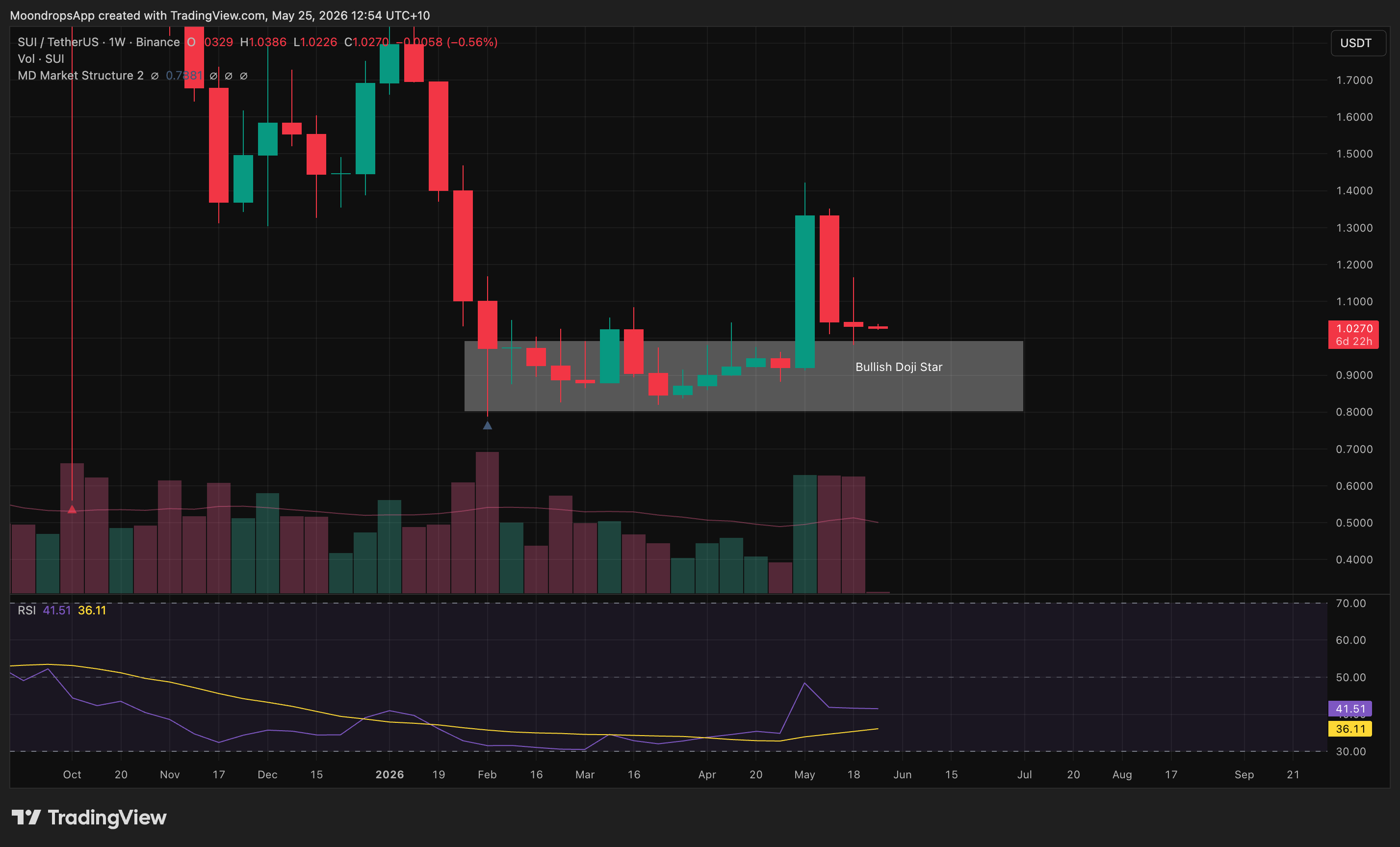
SUIUSDT $1.0328
Bias: Long
Thesis: Support behavior and bullish candlestick evidence make SUI a tactical rebound candidate, but weekly momentum was still negative at -1.06% and volume delta was negative.
Trigger condition: Prefer confirmation through reclaiming short-term momentum and holding support on any pullback.
Invalidation condition: A decisive weekly or early-week loss of support with renewed negative volume delta invalidates the mean-reversion case.
Target logic: First target is mean reversion toward the prior weekly range midpoint; extension requires broader alt breadth to improve.
Risk factors: RSI remains below 50, BTC participation is weak, and the broader market is still in Weak Downtrend.
Confidence: Medium
WLDUSDT $0.2932
Bias: Long
Thesis: WLD was the strongest prior long scorecard winner and remains a support-bound mean-reversion candidate after a +24.29% weekly close.
Trigger condition: Look for continuation only if it holds above reclaimed support and avoids a sharp reversal in volume delta.
Invalidation condition: Failure back below support or a return to bearish candle pressure invalidates the long setup.
Target logic: Target continuation into the next resistance zone only after support retests hold.
Risk factors: A strong prior rebound raises chase risk, and BTC weakness can cap follow-through.
Confidence: Medium
FETUSDT $0.2084
Bias: Long
Thesis: FET qualified under support-bound mean reversion and closed +9.11%, showing better rebound behavior than most of the market.
Trigger condition: Confirmation requires support to hold while RSI and momentum continue improving.
Invalidation condition: A close back into support failure with negative volume delta removes the rebound setup.
Target logic: Initial target is a retest of the nearest overhead supply; higher targets need a broader AI/alt beta bid.
Risk factors: RSI is still below 50 and the weekly regime is not broadly risk-on.
Confidence: Medium
ICPUSDT $2.56
Bias: Long
Thesis: ICP held support and closed slightly positive at +0.67%, making it a lower-volatility mean-reversion candidate.
Trigger condition: Needs a higher low and positive momentum expansion to confirm.
Invalidation condition: Loss of support or a return to negative weekly momentum invalidates the setup.
Target logic: Target the next weekly supply zone only after momentum confirms.
Risk factors: Weak market conviction and limited upside ROC make this setup less forceful than WLD or FET.
Confidence: Medium
FILUSDT $0.956
Bias: Long
Thesis: FIL fits the support-bound rebound profile with bullish candlestick behavior and a +1.49% weekly close.
Trigger condition: Follow-through requires support to hold and volume delta to stop dragging.
Invalidation condition: A break below support with renewed bearish candles invalidates the long case.
Target logic: First target is mean reversion toward the next local resistance band.
Risk factors: Negative volume delta and market-wide bearish VWAP pressure can limit the bounce.
Confidence: Medium
Trade Setups 2: Bearish Trend Continuation
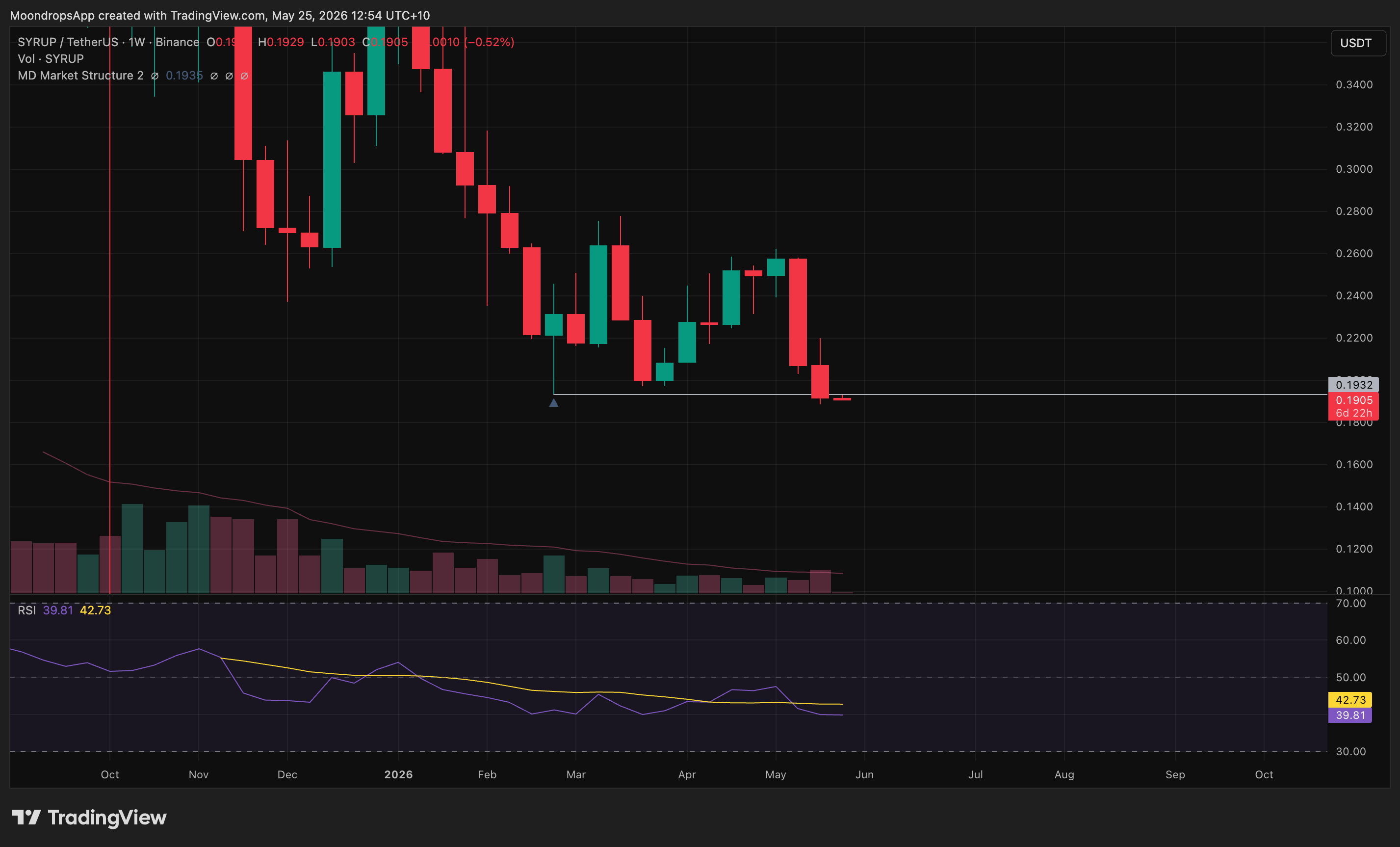
SYRUPUSDT $0.1915
Bias: Short
Thesis: SYRUP remains a bearish continuation candidate after closing -7.44% with bearish candles and bearish breakout structure.
Trigger condition: Continuation triggers on rejection into resistance or a fresh break below support.
Invalidation condition: A reclaim of broken structure with improving volume delta invalidates the short setup.
Target logic: Target continuation toward the next lower support shelf.
Risk factors: Positive volume delta into weakness can create squeeze risk.
Confidence: Medium
TLMUSDT $0.001437
Bias: Short
Thesis: TLM had one of the cleaner downside closes at -19.09%, with bearish candles, bearish breakout evidence, negative volume delta, and lower-high structure.
Trigger condition: Continuation requires failed rallies and renewed downside break pressure.
Invalidation condition: A reclaim of lower-high structure with positive momentum invalidates the short.
Target logic: Target the next lower weekly support zone after downside continuation confirms.
Risk factors: Low absolute price and sharp prior decline create high squeeze risk.
Confidence: Medium
ASRUSDT $1.06
Bias: Short
Thesis: ASR closed -8.23% and matched bearish candle, breakout, and negative volume-delta conditions.
Trigger condition: Prefer continuation only after failed support retests or rejection below broken levels.
Invalidation condition: Reclaiming support with positive weekly momentum invalidates the bearish setup.
Target logic: Downside target is the next weekly demand area, with partial risk reduction into sharp extensions.
Risk factors: Oversold behavior can interrupt trend continuation.
Confidence: Medium
GNSUSDT $0.478
Bias: Short
Thesis: GNS matched bearish trend continuation with bearish candles, negative volume delta, and weak momentum despite a smaller -1.04% weekly decline.
Trigger condition: Needs a lower-high rejection or downside momentum expansion to trigger.
Invalidation condition: A bullish divergence follow-through above resistance invalidates the short.
Target logic: First target is a retest of recent lows; extension requires market breadth to weaken again.
Risk factors: Bullish RSI divergence creates countertrend squeeze risk.
Confidence: Low
CITYUSDT $0.454
Bias: Short
Thesis: CITY closed -15.46% and matched bearish candle, breakout, and lower-high structure.
Trigger condition: Continuation triggers on failed rebounds into resistance or fresh downside breaks.
Invalidation condition: A reclaim of broken support with improving momentum invalidates the short.
Target logic: Target continuation into the next lower support zone, while respecting sharp rebound risk.
Risk factors: Prior-week scorecard showed volatile path behavior, including adverse short-direction days.
Confidence: Medium
Asset Drilldowns
BTCUSDT
BTCUSDT closed at 77,064.96, down 0.51% for the week, with RSI at 45.88 and negative volume delta. The weekly row had bearish candle behavior and bearish trend pressure, while the BTC sentiment workflow showed open-interest contraction, negative Coinbase premium, and long-dominant liquidations. The main read is not aggressive bearish expansion; it is deleveraging weakness with insufficient spot confirmation. BTC needs cleaner spot demand and better participation before the broader market can credibly shift from tactical rebound to durable risk-on.
ETHUSDT
ETHUSDT closed at 2,099.85, down 1.46%, with RSI at 39.33 and negative volume delta. The external ETH narrative was better than the weekly row: Vitalik and Ethereum Foundation discussion was constructive at the margin, but ETF-flow chatter remained cautious. That creates a divergence between long-term narrative support and near-term market structure. For this week, ETH is best used as a read-through asset: a reclaim with improving breadth would help validate selective rebound setups, while continued weakness would argue that narrative alone is not carrying market risk.
ZECUSDT
ZECUSDT was a clear upside outlier, closing at 662.87 with a +23.68% weekly ROC, RSI at 68.49, positive volume delta, bullish candle behavior, and bullish VWAP/EMA/SMA trend pressure. This does not fit the two main setup families cleanly; it is stronger than a support-bound mean-reversion candidate and should be treated as a leadership/outlier check. If ZEC keeps holding trend support, it can show that selective upside still exists inside a weak broader tape. If it rolls over, it would warn that the market is punishing extended winners while breadth remains fragile.
SOLUSDT
SOLUSDT closed nearly flat at 85.27, up 0.04%, with RSI at 38.35 and positive volume delta. The weekly row shows support behavior but still carries bearish trend pressure, so SOL is a useful contrast asset: it did not break down like weaker alts, but it also did not confirm leadership. A constructive SOL read requires support to hold while RSI and trend measures improve. If SOL loses support while BTC remains weak, it would reinforce the view that the rebound is still selective and fragile.
What Invalidates the Outlook
- Breadth failure: Positive rate-of-change assets falling back toward prior-week levels would invalidate the rebound-improvement case.
- Support failure: The support-heavy market state breaks if the 207 support-level assets fail to hold and bearish candles re-expand.
- BTC participation breakdown: BTC losing structure while Coinbase premium remains negative and open interest continues contracting would undermine risk appetite.
- Setup-family failure: Mean-reversion longs failing at support and bearish continuation shorts squeezing through invalidation levels would imply the current two-way setup board is losing coherence.
- Trend pressure persistence: Bearish VWAP/price trend staying near 358 assets would keep any upside attempts tactical rather than structural.
What to Watch This Week
- BTC spot confirmation: Watch whether BTC can stabilize with improving Coinbase premium and less liquidation-led flow.
- Breadth follow-through: Positive ROC and bullish candle counts need to hold or expand; otherwise last week's improvement becomes only a relief move.
- Range versus trend: Low-Volatility Coil expanded from 31 to 55, so compression resolution matters.
- Mean-reversion board: SUI, WLD, FET, ICP, and FIL need support to hold; failures would lower confidence in the long side.
- Bearish continuation board: SYRUP, TLM, ASR, GNS, and CITY remain vulnerable unless they reclaim broken structure.
- Major read-throughs: ETH needs market structure to catch up to narrative; SOL needs positive volume delta to translate into stronger trend behavior; ZEC needs to hold its leadership without becoming an exhaustion signal.
Disclaimer
This newsletter is for informational and educational purposes only and does not constitute financial advice. Crypto markets are volatile, and all trading decisions require independent research, risk management, and position sizing discipline.