Deleveraging Reset Leaves Crypto Market Bearish but Stretched

Executive Takeaway
The Binance weekly close for the week ending June 8, 2026 stayed defensive. Weak Downtrend remained the dominant regime, conviction held at 4.0/10, and 374 of 401 assets closed with negative weekly rate of change. The market is too weak for broad risk-on language, but it is also stretched enough that fresh shorts need tighter risk control. The core setup is a bearish tape with late-stage stress: 205 assets are sitting at support, 149 show bullish RSI divergences, and 116 are in an oversold regime. That leaves two practical paths this week: favor bearish breakdowns where structure keeps failing, and treat counter-trend longs as smaller tactical trades that require confirmed support. BTC is the key read-through after a 14.04% weekly decline, a large open-interest reset, and mixed end-of-week spot-flow evidence. External market coverage broadly confirms the same story: derivatives stress, liquidations, and weak spot demand drove the week, while stabilization evidence remains early.
Weekly Market State
The weekly state remains bearish. Weak Downtrend led with 219 assets, followed by 144 Range-Bound assets, 121 Strong Downtrend assets, and 116 Oversold Regime assets. Breadth was heavily negative, with only 27 assets showing positive weekly rate of change versus 374 negative. Structure also stayed weak: 296 assets printed lower lows, 373 traded below weekly VWAP, and negative volume delta appeared across 291 assets.
The final aligned daily close showed a market leaning even more oversold in the short window. Oversold Regime led the daily close state with 344 assets, while 273 assets still had negative daily rate of change and 393 held RSI below 50. Positive daily rate-of-change breadth did recover to 131 assets, but the daily structure still carried 382 lower lows and 362 assets below their 200-SMA price trend. The board is tactical, not broadly constructive.
What Changed From Last Week
- Breadth: negative weekly rate-of-change assets rose by 107, while positive rate-of-change assets fell by 100.
- Support/candles: bearish breakouts rose by 87 and bearish candlestick patterns rose by 75, while bullish candlestick patterns fell by 48.
- Trend: bearish lower lows rose by 51, bullish higher lows fell by 40, and bearish VWAP/price trend expanded by 17.
- Structure: support tests stayed high at 205 assets, so weakness is pressing into major floors rather than moving through clean open air.
- Regime: Oversold Regime rose by 75 assets, Range-Bound fell by 65, and Low-Volatility Coil fell by 27.
- Conviction: conviction remained 4.0/10, but the character shifted from slow-bleed consolidation toward more forceful downside stress.
- Volume: high relative volume rose by 89 assets and extreme negative z-scores rose by 83, consistent with more climactic selling pressure than last week.
Category Rotation
Category performance looked like relative damage control, not true leadership. Across 401 matched symbols, the average category-mapped close ROC was -16.45% and the median was -18.69%, with only 27 positive symbols against 374 negative.
Oracle and Data was the best qualified category, but it still fell 8.62% on average across four symbols. Infrastructure screened second at -8.79% mean close ROC, but the median was much weaker at -19.30% and the result was outlier-driven by EPICUSDT. That makes it a poor candidate for broad infrastructure leadership. Derivatives ranked third at -12.09% mean close ROC with a 22.22% win rate.
The weakest qualified groups were NFT and Collectibles at -25.54% mean close ROC and Gaming at -20.66%. NFT and Collectibles had a 0% win rate across five symbols. Gaming had a small number of positive outliers, but PORTALUSDT dragged the category lower. Capital did not rotate into a clean risk-on pocket; it simply punished some areas less severely than others.
How the Week Unfolded
- May 31 close: Weak Downtrend already led, but short-term rate-of-change breadth was still positive with 262 assets up and 147 down.
- June 1 close: Weak Downtrend persisted as breadth deteriorated; positive rate-of-change breadth fell to 155 assets and negative breadth rose to 251.
- June 2 close: the first major breadth break arrived, with only 25 positive rate-of-change assets versus 391 negative and bearish regime count rising to 433.
- June 3 close: the market attempted relief, with 241 positive rate-of-change assets, but bearish regime count stayed elevated at 439.
- June 4 close: the dominant daily regime flipped to Oversold Regime, while bearish regime count rose to 472 and only 34 assets had positive rate of change.
- June 5 close: stress peaked in the daily path, with 493 bearish-regime assets and only 17 positive rate-of-change assets.
- June 6 close: oversold pressure persisted, but positive rate-of-change breadth recovered to 131 assets, leaving a stabilization attempt rather than a confirmed reversal.
BTC Sentiment
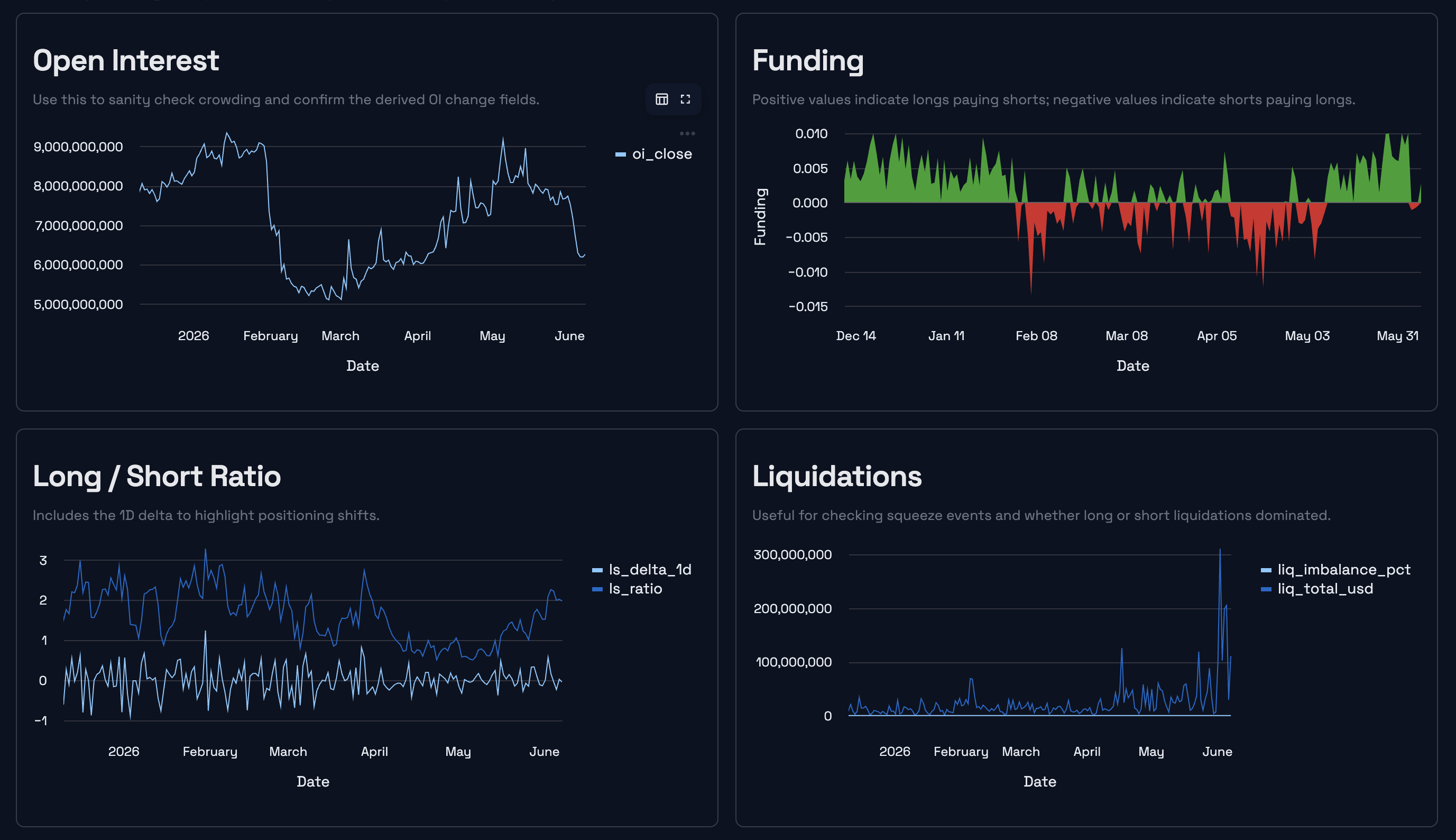
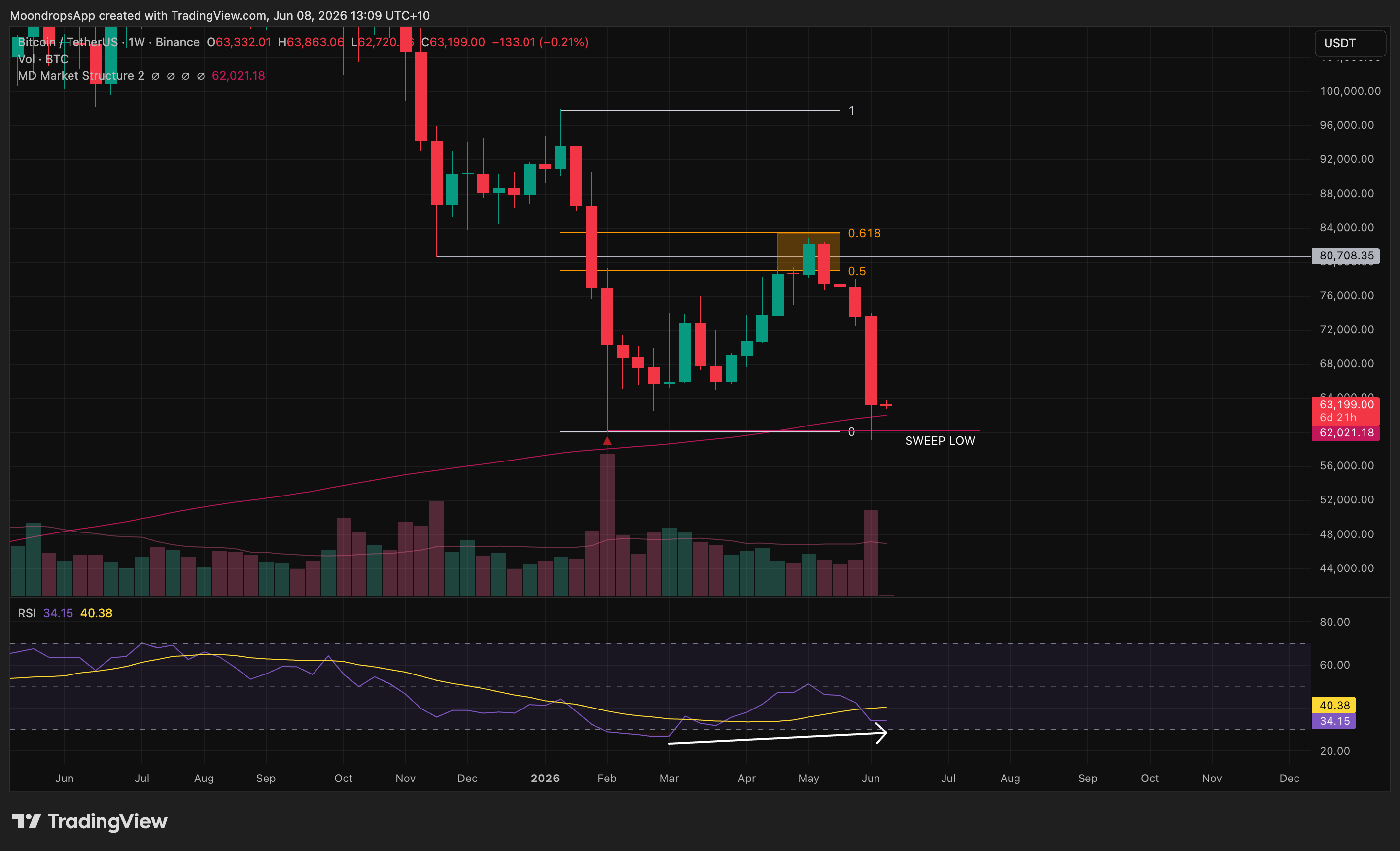
BTC closed the week at $63,332.01, down 14.04% from the weekly open. The BTC sentiment data reads mixed rather than cleanly bullish or bearish. Open interest contracted sharply from roughly $7.52B to $6.26B, while weekly open-interest change deteriorated to -19.08%. That points to deleveraging and forced risk reduction, not a healthy leverage expansion.
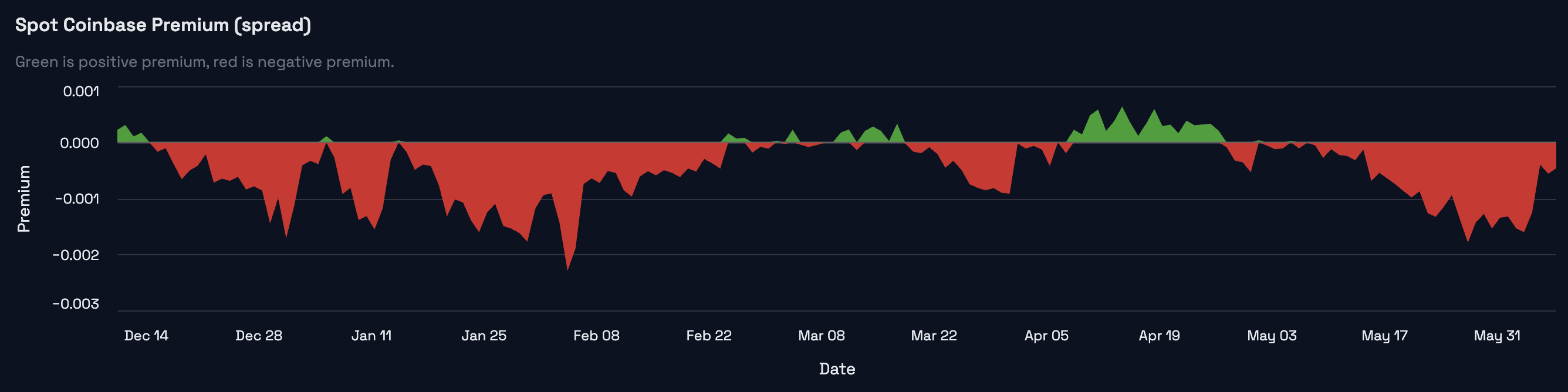
Spot-flow evidence was mixed. BTC spot CVD remained net negative, Coinbase premium stayed negative, and BTC closed with negative weekly volume delta. At the same time, the latest row showed positive spot volume delta, a less-negative Coinbase premium than the weekly low, and a small one-day rebound in open interest. The BTC setup is best framed as an oversold counter-trend attempt inside a damaged weekly structure. The bounce case needs BTC to hold $60,000-$62,000 and reclaim $65,000-$67,000 without rebuilding unstable long leverage.
News and Catalysts
- Signal: Bitcoin derivatives were already flashing warning signs as BTC fell below $70,000 early in the week. Why it matters: elevated open interest and funding created a fragile setup that matched the broader leverage-stress read. Watch: whether open interest rebuilds while spot demand stays weak. Sources: CoinDesk.
- Signal: BTC tested the $62,000 area after a fast multi-day selloff. Why it matters: external reporting described billions in liquidations, which supports the view that deleveraging, not orderly rotation, defined the week. Watch: a clean loss of the $60,000-$62,000 support band. Sources: Decrypt, Blockonomi.
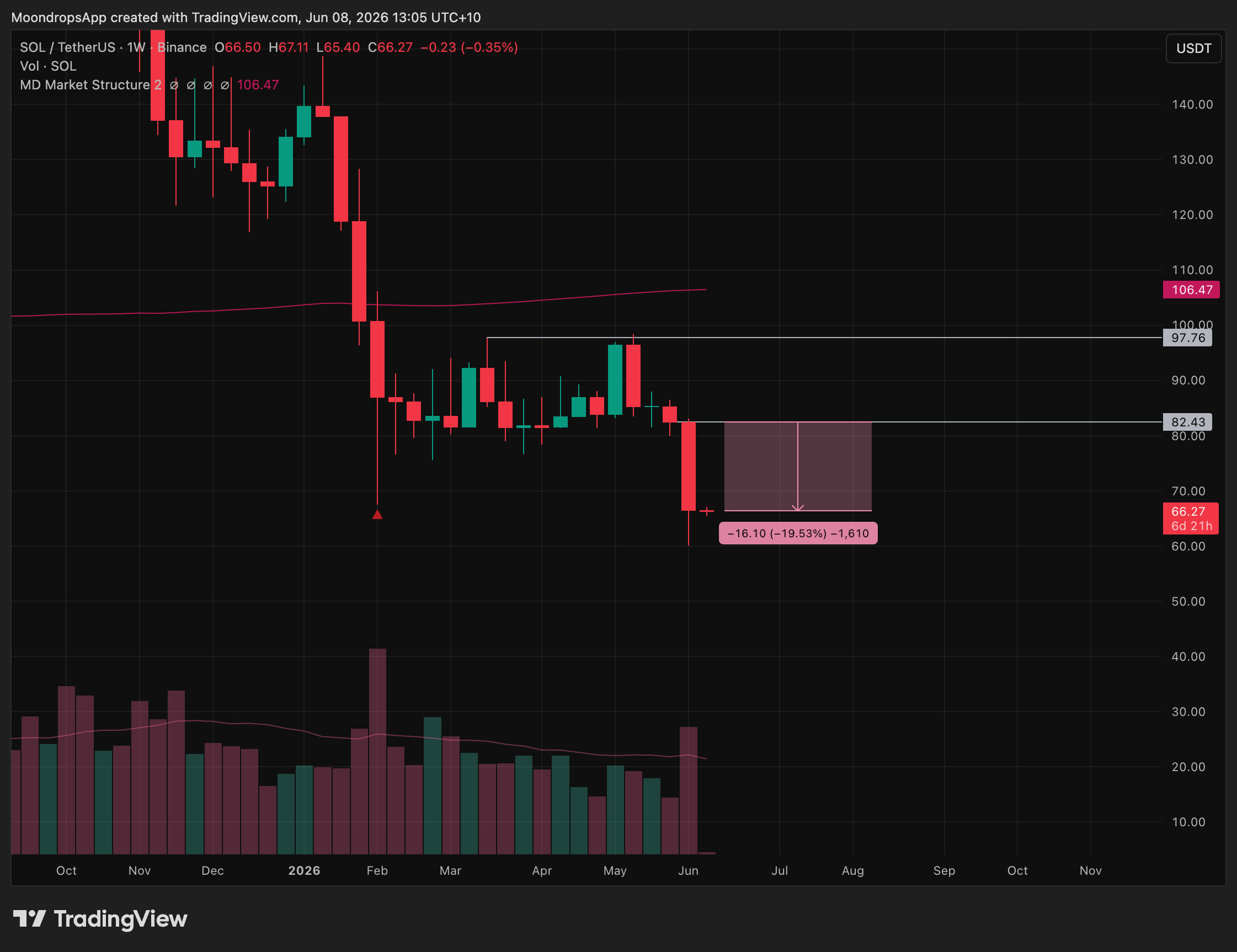
- Signal: Solana had both bearish market pressure and mixed supply-side headlines. Why it matters: a proposed acceleration of emission reductions is constructive in theory, but June unlock headlines and a breakdown toward the low $60s keep the price setup bearish until reclaimed. Watch: whether SOL can recover $65-$70 or turns support into resistance. Sources: TradingView News, CryptoBriefing, Blockonomi.
- Signal: Avalanche had real-world adoption headlines around FIFA ticketing. Why it matters: adoption news is not enough to override the weekly structure when AVAX closed down 24.09%, with high relative volume, negative volume delta, and bearish trend pressure. Watch: whether AVAX can reclaim the $7 area and hold it on improving breadth. Sources: Bitcoin.com News, CoinTrust.
Last Week Setup Scorecard
Last week rewarded bearish continuation and punished most counter-trend bounce attempts. The prior bearish structural continuation board produced a 5/5 directional hit rate, with SOLUSDT as the cleanest win and TAOUSDT, POLYXUSDT, RLUSDUSDT, and TRXUSDT classified as volatile wins. The prior bullish oversold-support board produced a 0/5 directional hit rate on weekly close outcome. PORTALUSDT, IOUSDT, TRUMPUSDT, and BIOUSDT were mixed because they offered favorable daily excursions before failing into the weekly close, while IDUSDT failed outright.
That scorecard argues for keeping bearish continuation as the primary family this week. Counter-trend trades can still work because oversold pressure is extreme, but last week showed that early bounce attempts were fragile unless they quickly converted into confirmed reclaim structure.
Top Setups This Week
Trade Setups 1: Bearish Breakdown Continuation
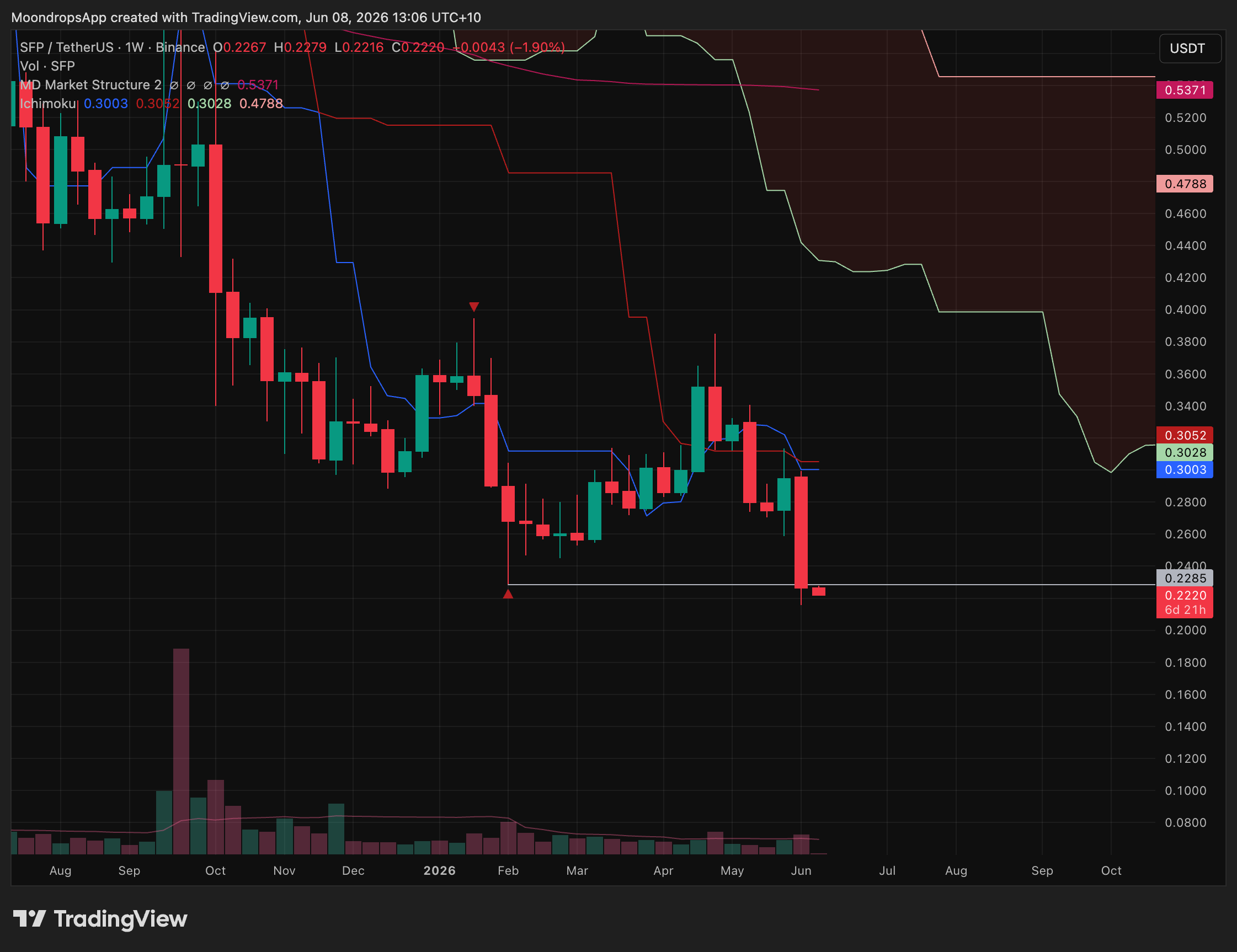
SFPUSDT $0.2263
Bias: Short
Thesis: SFP matched the full bearish continuation filter with bearish breakout, bearish candlestick, and bearish Ichimoku Tenkan/Kijun cross evidence.
Trigger condition: Favor continuation if price fails to reclaim broken weekly support on a bounce and volume delta remains negative.
Invalidation condition: A weekly reclaim above the breakdown area with improving breadth and positive volume delta.
Target logic: Use prior support shelves as downside magnets and trail once fresh lows extend.
Risk factors: Broad oversold breadth can force abrupt short squeezes even in valid downtrends.
Confidence: High
JOEUSDT $0.0311
Bias: Short
Thesis: JOE matched the full bearish continuation filter, and its -20.46% weekly close ROC confirms that sellers controlled the weekly tape.
Trigger condition: Favor continuation on failed retests into former support or bearish lower-high continuation.
Invalidation condition: A sustained reclaim of the breakdown level with RSI recovery and positive volume delta.
Target logic: Target continuation into the following liquidity pocket, then reduce exposure into extended downside.
Risk factors: Low-price assets can gap sharply during relief rallies.
Confidence: High
REQUSDT $0.0555
Bias: Short
Thesis: REQ matched the full bearish continuation filter and closed down 17.29%, keeping it aligned with the dominant weekly regime.
Trigger condition: Continuation remains active if bounces stall below reclaimed resistance and bearish candles persist.
Invalidation condition: A weekly close back above the failed support zone with improving market breadth.
Target logic: Use lower-low continuation as the primary target path and avoid pressing after vertical extensions.
Risk factors: Oversold divergences across the market can reduce follow-through quality.
Confidence: High
SOLUSDT $66.50
Bias: Short
Thesis: SOL is a major-asset breakdown candidate after closing down 19.34%, with negative volume delta, RSI near 31, and weak recovery evidence.
Trigger condition: Favor continuation if the $65-$70 reclaim fails and price accepts back below broken support.
Invalidation condition: A decisive reclaim of $70 with rising spot demand and broad Layer 1 participation.
Target logic: Stage downside targets around the next liquidity shelves below the breakdown, with partial cover into forced-selling extensions.
Risk factors: Supply-reduction headlines and oversold positioning can create sharp counter-trend rallies.
Confidence: Medium
AVAXUSDT $6.819
Bias: Short
Thesis: AVAX closed down 24.09% with high relative volume, negative volume delta, RSI near 31, and strong ADX, keeping trend pressure active.
Trigger condition: Favor continuation if the $7 area acts as resistance after any relief bounce.
Invalidation condition: A sustained reclaim of $7 with positive volume delta and improving Layer 1 breadth.
Target logic: Target lower liquidity shelves while managing exposure aggressively if adoption headlines spark a squeeze.
Risk factors: Avalanche adoption news can create narrative-driven rallies that temporarily overpower weak structure.
Confidence: Medium
Trade Setups 2: Oversold Counter-Trend Reversion
BTCUSDT $63,332.01
Bias: Long
Thesis: BTC matched the oversold counter-trend family, with support-level context, bullish RSI divergence evidence, and a market-wide deleveraging reset behind it.
Trigger condition: Favor a tactical long only if BTC holds $60,000-$62,000 and reclaims $65,000-$67,000 with stable open interest.
Invalidation condition: A clean loss of $60,000-$62,000 with renewed negative spot flow and expanding downside breadth.
Target logic: First target is mean reversion into the $65,000-$67,000 reclaim zone, then reassess for continuation.
Risk factors: Coinbase premium remains negative, cumulative spot flow is still weak, and leverage can rebuild before spot demand confirms.
Confidence: Medium
TRUMPUSDT $1.667
Bias: Long
Thesis: TRUMP matched the full oversold counter-trend filter, but last week's similar meme-led bounce attempts were fragile.
Trigger condition: Favor only after support holds and price reclaims the short-term breakdown with volume confirmation.
Invalidation condition: A fresh weekly low or failure to hold support after the first bounce attempt.
Target logic: Target the nearest failed support shelf, not a full trend reversal.
Risk factors: Headline sensitivity, liquidity gaps, and weak broad meme-category participation.
Confidence: Low
LDOUSDT $0.272
Bias: Long
Thesis: LDO matched the oversold counter-trend family and offers a cleaner support-reversion structure than many broad-market assets.
Trigger condition: Favor a bounce only if support holds and RSI divergence converts into a higher low.
Invalidation condition: A close below support with expanding negative volume delta.
Target logic: Target the first failed breakdown shelf and reduce exposure if momentum stalls.
Risk factors: Broad DeFi liquidity remains weak and the setup conflicts with the dominant downtrend.
Confidence: Low
SUSHIUSDT $0.1716
Bias: Long
Thesis: SUSHI matched the oversold counter-trend filter and sits in the part of the market where seller exhaustion can produce fast mean reversion.
Trigger condition: Support must hold, and any bounce should show improving breadth rather than isolated illiquidity.
Invalidation condition: A support break with negative volume delta or failed reclaim after an initial bounce.
Target logic: Use the nearest weekly resistance shelf as the primary target and avoid overstaying the counter-trend move.
Risk factors: DEX-related assets remain exposed to broad risk-off conditions and liquidity can disappear quickly.
Confidence: Low
GALAUSDT $0.00263
Bias: Long
Thesis: GALA matched the oversold counter-trend filter, but Gaming was one of the weakest categories of the week.
Trigger condition: Favor only if support holds and the Gaming category stops underperforming on breadth.
Invalidation condition: A fresh weekly low or another category-wide deterioration in Gaming assets.
Target logic: Target a short mean-reversion move into the first failed support shelf.
Risk factors: Gaming category weakness, low-price volatility, and broad-market bearish structure.
Confidence: Low
Asset Drilldowns
BTCUSDT
BTC carries the clearest market-wide read-through. It closed at $63,332.01, down 14.04% for the week, with RSI at 34.24, high relative volume at 1.59, and negative weekly volume delta. The setup is counter-trend long, but the reason is exhaustion after deleveraging, not trend strength. The clean bull case is a hold above $60,000-$62,000 followed by a reclaim of $65,000-$67,000 while open interest stays controlled. A loss of $60,000-$62,000 would turn the bounce thesis into another failed support attempt.
SOLUSDT
SOL is a high-signal bearish continuation drilldown. It closed at $66.50, down 19.34% for the week, with RSI at 31.28, ADX at 33.55, and negative volume delta. Every aligned daily close showed negative close ROC, with the largest drop on June 3. Solana had potentially constructive supply-reduction headlines, but also unlock and breakdown pressure. The key line is whether SOL can reclaim and hold $65-$70; without that, relief rallies remain suspect.
AVAXUSDT
AVAX closed at $6.819, down 24.09%, with RSI at 31.26, ADX at 37.74, high relative volume, and negative volume delta. The price structure is bearish continuation, and the daily path deteriorated sharply into June 6 before a small final-day loss. Avalanche had real-world adoption headlines around FIFA ticketing, but the market did not reward the asset in price structure. That makes AVAX a useful test case for whether catalysts matter in a tape dominated by deleveraging. A reclaim of $7 would soften the short case; failure below that level keeps breakdown pressure active.
ZECUSDT
ZEC is a useful drilldown because its weekly path shows a violent late-week reversal after early relative strength. It closed at $440.60, down 22.57%, with high relative volume at 3.39, ADX at 31.73, and negative volume delta. The daily path was unstable: ZEC rose 7.67% on June 1 and 11.95% on June 3, then fell 25.96% on June 5, 15.24% on June 6, and 6.95% on June 7. That pattern argues for caution around any immediate bounce. ZEC needs to prove that the late-week liquidation phase has ended before it deserves aggressive long exposure.
NEARUSDT
NEAR gives the drilldown section a useful failed-strength example. It closed at $2.059, down 11.25%, with high relative volume at 3.04, RSI still elevated at 57.20, and weak ADX at 16.98. The asset outperformed early in the week, including a 13.71% daily rise on June 2 and a 7.19% rise on June 4, before reversing sharply with a 21.90% decline on June 5 and another 10.50% decline on June 6. That is not a classic oversold structure; it is a rejected relative-strength move. NEAR needs to stabilize above the late-week breakdown area, or remaining momentum pockets can unwind further.
What Invalidates the Outlook
The bearish continuation side weakens if breadth flips from defensive to constructive. Positive weekly rate-of-change assets need to expand materially, bearish lower lows need to contract, and negative volume delta needs to stop dominating the market. A BTC reclaim of $65,000-$67,000 with stable or falling leverage would also reduce the probability of another immediate downside leg. For SOL and AVAX specifically, reclaiming broken support zones and holding them as support would invalidate the clean breakdown continuation case.
The counter-trend bounce side fails if support breaks instead of holding. BTC losing $60,000-$62,000, oversold assets failing to reclaim short-term breakdown levels, or bullish RSI divergences rolling over into fresh lows would argue that the market has not finished liquidating weak hands. If that happens, the board should lean more heavily toward continuation shorts and reduce exposure to low-confidence mean-reversion trades.
What to Watch This Week
- BTC $60,000-$62,000 support and $65,000-$67,000 reclaim behavior.
- Whether open interest rebuilds too quickly after the reset or stays controlled during any bounce.
- Positive versus negative rate-of-change breadth across the full Binance universe.
- Bearish lower lows and negative volume delta counts; both need to contract before the market state improves.
- SOL behavior around $65-$70 and AVAX behavior around $7.
- Whether category performance remains broad damage control or starts producing real leadership with positive median returns.
- ZEC and NEAR late-week reversals; both need stabilization before their drilldown cases become constructive.
Disclaimer
This newsletter is for informational and educational purposes only and does not constitute financial advice. Crypto markets are volatile, and all trading decisions require independent research, risk management, and position sizing discipline.